Custom Linen Trousers and Chinos: A Manufacturing Guide for Brands
- Share
- publisher
- LINENWIND
- Issue Time
- Sep 14,2026
Summary
Custom linen trousers and chinos are a construction project before a style decision. This guide covers the silhouettes brands buy, the fabric weight that keeps a leg hanging cleanly, waistband, fly, pleat and pocket engineering, lining, the inseam and sizing questions that meet first-wash shrinkage, finishing and AQL 2.5 inspection, and the cost, MOQ and lead time for a bottoms programme. From LINENWIND, a Dongguan linen garment manufacturer, MOQ 60 pcs per style per colour.
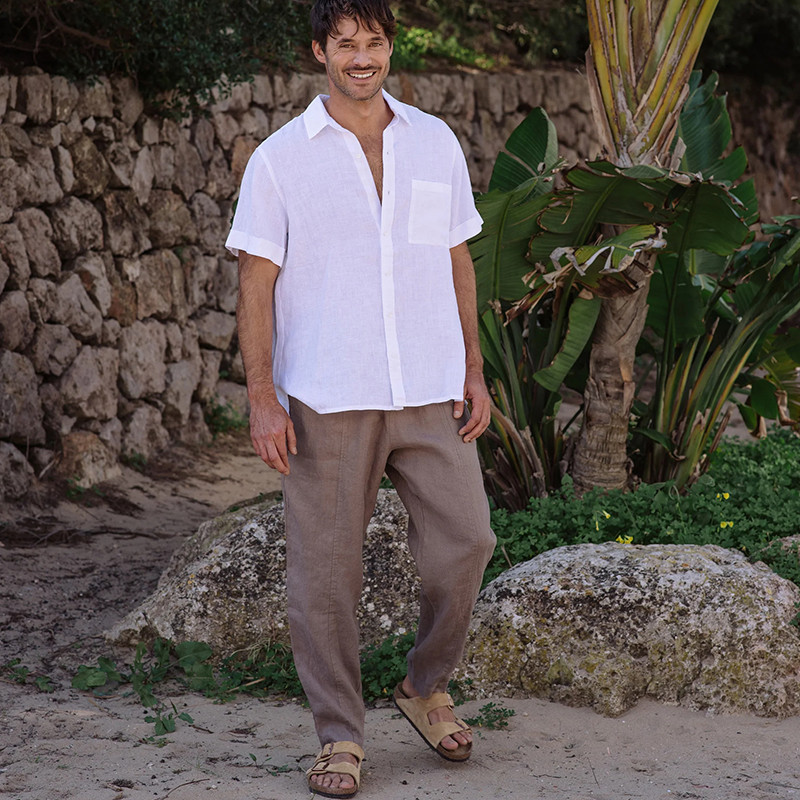
Custom linen trousers are the least understood bottom in the linen wardrobe, and the reason is construction rather than fabric. A shirt is cut from a flat panel and hangs from the shoulders, so the cloth is free to drape as it likes. A trouser has to hold a waist, carry a fly, survive a crotch seam, support pockets and stay straight through the leg, all while the fabric is trying to relax and move. That is a different engineering problem, and it is why a trouser programme is priced, sampled and quality-checked differently from a top. This guide sets out how linen trousers and chinos are actually manufactured. It covers the silhouettes a brand can buy, the fabric weight that keeps a leg hanging cleanly, waistband and fly engineering, pleats and darts, pocket and lining construction, the inseam and sizing questions that decide fit, finishing and quality control, and the cost, MOQ and lead-time picture for a bottoms programme. The figures are the ones we publish: MOQ 60 pieces per style per colour, counter samples in 7-12 days with a real sampling window of 7-14 days, bulk production in 25-35 days, a first order of roughly 35-60 days, first-wash shrinkage held to 3-7 percent, fabric weights from about 100 to 260 GSM, and AQL 2.5 inspection. Linenwind is a Dongguan linen garment manufacturer with more than 20 years of OEM and ODM experience. If you are still mapping the category, our overview of linen pants manufacturing and custom OEM supply is the place to start, and the wider range is described in the FAQ on what types of linen clothing can be manufactured. A trouser is a load-bearing garment. The waistband carries the whole weight of the piece, the fly and front closure take repeated stress, the crotch seam is the highest-stress joint in the garment, and the pockets are anchor points that pull on the side seams every time a hand goes in. In a knit these forces are absorbed by stretch. In linen, a low-stretch woven with a lively hand, they have to be absorbed by construction: interfacing, reinforcement, seam type and the way the cloth is cut relative to its grain. Linen adds a second variable that tops rarely face: gravity acting on a long, narrow panel. A trouser leg is a hanging strip of cloth, and the way that strip falls - its drape - is decided by weight, weave and finish long before a sewing machine is involved. Too light and the leg flutters and creases into the knee; too heavy and it stands away from the body and feels stiff. The maker's job is to hold a chosen silhouette steady while the cloth relaxes, which is why the fabric decision for a trouser is not interchangeable with the fabric decision for a shirt from the same collection. The practical consequence for a brand is that a trouser programme needs its own specification, not a shirt spec with longer legs. Two extra pages of measurement, a decision on waistband and fly construction, and a clear view of what the finish does to the leg length will save a full sampling round. How linen behaves between cut and first wash is set out in our guide to linen shrinkage control, and the category context sits alongside our overview of linen pants and bottoms manufacturing in China. A trouser spec is a construction document, not a style sheet. Waistband build, fly type, pocket depth, crotch seam and finished inseam decide whether the garment sells; colour and silhouette only decide whether it is noticed. The silhouette is the first specification to freeze, because it determines how much fabric the leg consumes, how the drape reads, and what pattern work the style needs. For linen, the four silhouettes brands buy most often are the straight leg, the tapered leg, the wide leg and the chino. Each asks something different of the cloth and the construction. A straight-leg trouser is the safest linen bottom. The leg falls vertically from the hip with a consistent width from thigh to hem, which suits the natural drape of the fibre and forgives small variations in body shape. A tapered trouser narrows from knee to hem, which demands more precise grain alignment because any twist in the cut becomes visible where the leg tightens. A wide-leg trouser uses the most fabric and lives or dies on weight: too light and the leg collapses, so wide-leg styles are usually cut from the heavier end of the range. The chino is a construction rather than a silhouette - a clean-front, flat-front trouser in a slightly firmer weave - and it works in linen when the fabric has enough body to hold a pressed front. Table 1: how the four common linen bottom silhouettes differ in what they ask of the fabric and the factory. The heavier the silhouette, the more the cloth weight decides whether it works. Freezing the silhouette early also fixes the pattern cost. A straight-leg block can be graded into a tapered version with limited re-cutting, while a wide-leg style usually needs its own block because the leg angle changes. That difference shows up in sampling time and in the number of fit rounds, which is why brands that plan a bottoms range should decide the silhouette family before the first sample rather than after it. The single most useful number for a trouser fabric is its weight in GSM, and the same linen that makes an excellent summer shirt is often too light for a leg. Across the specifications we hold, the range runs from roughly 100 to 260 GSM. Shirts usually sit in the lighter half; trousers and chinos live in the middle to upper half, where the cloth has enough mass to hang cleanly and enough body to resist collapsing at the knee. Weight is only half the story. Weave and finish change how a given weight behaves: a plain weave reads firmer and more formal, a twill drapes more softly with a subtle diagonal, and a heavier washed or enzyme-finished linen feels broken-in from the first wear. For a trouser, the target is a cloth that hangs without stiffness - firm enough that a flat front stays flat through a working day, soft enough that it moves with the body when sitting. Consumption follows weight as well as silhouette. A wide-leg trouser in a heavy cloth can take noticeably more fabric per piece than a slim tapered shape in a light one, and that difference feeds directly into the unit price. How weight, weave and finish move the cost of the cloth itself is explained in our guide to how much linen fabric costs, and the specifications a manufacturer typically keeps on hand are listed in the FAQ on what types of linen fabrics linen clothing manufacturers use. Choose weight by what the leg has to do. A trouser that must hang straight and stay pressed needs more body than a shirt or a loose summer dress from the same fabric family. The waistband is where a cheap trouser and a good one separate. It is the part that touches the body all day, the part that controls whether the front sits flat, and the part that carries the load. In linen, which has little natural give, the waistband has to be built rather than relied upon. A properly built linen waistband uses a fusible or sewn-in interlining to give the band structure without making it rigid, and on curved or extended waistbands a curtain and canvas combination distributes pressure so the band does not roll. The closure matters just as much: a hook and bar, a button, or a hidden extension each behave differently under load, and the wrong choice shows up as a gaping front after a few wears. Belt loops are a small detail with a large effect on how the garment reads - a chino usually wants them, a dressier trouser may not. The band depth, interlining and closure should be written into the tech pack, because they are the first things a factory will otherwise decide by habit. Getting the technical documentation right is covered in our guide on how to create a clothing tech pack. How the front of a trouser is shaped decides how it reads and how it fits across the seat and hip. A flat front is the cleaner, more modern choice and the standard for chinos; single or double pleats add room through the hip and thigh and suit heavier cloths and looser silhouettes. Darts are the quieter alternative, taking in fabric at the back to shape the waist without adding visible folds at the front. In linen, the choice of front treatment interacts with the fabric's tendency to crease. Pleats press well and hold a line, which is helpful in firmer cloths, but a poorly set pleat in a soft linen can open and sag. Darts behave more discreetly and are easier to control on light and mid-weight fabrics. The practical rule is to match the front treatment to the weight: flat fronts in the mid to heavy range where the cloth has enough body to stay smooth, pleats where the silhouette is relaxed or the fabric is heavier, darts where the styling is clean and the cloth is lighter. Whichever route is chosen, the front and back panels have to be cut so that the shaping is balanced - taken in evenly on both sides and both legs - or the garment will twist. This is the stage where a good marker and a stable cut matter far more than any cosmetic detail, and it is one of the reasons a linen trouser sample is worth taking the time to check before bulk fabric is committed. Pockets are the most common point of failure in a linen trouser, because they are anchored in the side seam and loaded every day. A side seam pocket that is too shallow lets contents spill when sitting; one that is too deep sags and pulls the line of the trouser out of shape. The fix is structural: anchored pocket bags, a depth matched to the garment's intended use, and a bar tack at the top and bottom of the opening so the stress point is distributed rather than concentrated. The pocket bag material also matters. Linen itself is a poor choice for the bag, because it is bulky and low-friction; a lighter pocketing fabric reduces bulk at the hip and slides more easily, which keeps the outer line clean. For back pockets, whether patch or welt, the same principle applies: they must be positioned on the curve of the seat rather than flat across it, or they will gape when the wearer sits. Lining is a decision brands often overlook, and it is rarely all-or-nothing. A full lining is normally unnecessary in a linen trouser and would fight the fibre's breathability; a partial half-lining across the front to the knee, or lined pocket bags alone, is often enough to stop the fabric catching on the leg and to hide the construction. For styles that need to stay crisp - a tailored linen trouser or a uniform bottom - a light front lining is a sensible trade of a little warmth for a much cleaner line. The choice should be made against the garment's end use: resort and summer styles usually need none, smart and workwear styles often benefit from a partial one. Fit complaints on linen trousers are almost always length complaints, and length is decided by two numbers: rise and finished inseam. Rise is the distance from the crotch seam to the top of the waistband, and it controls where the trouser sits on the body; inseam is the inside leg length from crotch to hem. Both have to be specified per size in the grading, not assumed from a single base sample, or the range will fit three sizes well and the rest badly. The complication particular to linen is that the finished inseam moves after the first wash. Because linen relaxes and shrinks, a leg that measures exactly 78 cm at the factory can measure a little less once the customer has washed it, and the amount depends on how the fabric was pre-shrunk and finished. Pre-shrinking and a controlled wash hold first-wash shrinkage to 3-7 percent, but even that band is wide enough to matter over a full leg length, so the specification has to account for it rather than treat the factory measurement as final. Table 2: the measurements that decide whether a linen trouser fits. Inseam and rise are the two that generate most returns, and both interact with shrinkage. The practical approach is to build the size chart from a measured base sample in the target market's size system, grade around it, and confirm the finished inseam after the pre-shrink finish rather than before it. Multi-market ranges should be planned deliberately, because a US size 32 and an EU 48 are not the same body even when the waist measurement matches. How shrinkage is held within a controlled band is explained in the FAQ on how much linen shrinks and how to prevent it, and the wider problem of durability over a garment's life is covered in our guide to linen clothing durability. Finishing is what turns a length of linen into a trouser that behaves. Because the fibre relaxes and shrinks on first wash, a trouser that is cut and sewn and packed immediately will change shape in the customer's hands. Pre-shrinking the fabric, or running a controlled wash on the finished garment, is what holds the change to the 3-7 percent band we quote and keeps the leg length close to the size chart. The finish also sets the hand. A washed or enzyme-finished linen feels broken in and soft against the skin, which suits casual and resort trousers; a firmer finish holds a crisper front, which suits chinos and any tailored style. Garment-dyeing is a third option that gives depth of colour and works well on small runs, though it brings its own shrinkage and trim considerations that have to be tested on the sample. Matching the finish to the style is a real decision, not a default, because the same base cloth can read soft or sharp depending on what is done to it. Pressing and packing close the process. A trouser that is pressed on the leg line, folded correctly and packed flat will reach the customer looking as intended; one that is bundled loosely will arrive creased in exactly the places that are hardest to press out. The available finishes and how they change hand and cost are described in our guide to linen fabric finishing methods. Specify the finish on the sample, not after bulk. Pre-shrink, wash and press all move the finished measurements, the hand and the colour, so the approved sample must already be in its final state. Inspection for a trouser programme is run against AQL 2.5, the acceptance level we work to, which balances the practical realities of a sewn garment against a brand's need for consistency. The point of a defined sampling plan is that it turns "does it look right?" into a measured decision with a pass or fail outcome, so both sides agree on what is acceptable before the goods ship. Linen trousers have a specific set of defects inspectors watch for, and most of them are construction rather than fabric faults. The check is done against the approved sample, which is the reference for fit, colour and finish. Running the inspection at the right moment is as important as the level itself. An in-line or mid-production check catches a construction fault while the line can still be corrected; a final random inspection before shipment confirms that the finished lot matches the sample. A brand ordering bottoms for the first time should ask to see the inspection report against the sample rather than a written assurance. How sampling and acceptance work is explained in our guide to linen garment quality inspection and AQL sampling. Because a trouser uses more fabric and more labour than a top, the cost structure of a bottoms programme is heavier, and the fixed costs carry further. Our minimum is 60 pieces per style per colour, which is the quantity at which a style can be cut and sewn without the set-up cost dominating the unit price. Below that, the pattern work, marker planning, sampling and per-style trims are spread across too few pieces. Unit cost is built from fabric, labour, the fixed set-up share and margin. For linen clothing the split we work to is fabric at roughly 30-45 percent of the garment cost and labour at roughly 25-35 percent, with the remainder covering the fixed set-up and margin. In a trouser the fabric share tends to sit at the higher end of that band, because the garment consumes more cloth, and the labour share is driven by the number of operations: a flat-front chino is a simpler build than a lined, pleated, welt-pocketed tailored trouser, and the difference is visible in both price and sampling time. Timing follows the same construction logic. A counter sample takes 7-12 days, with 7-14 days realistic when a fabric has to be sourced or a finish tested; bulk production runs 25-35 days from approved sample and deposit; a first order lands at roughly 35-60 days end to end before shipping. A multi-style bottoms range repeats the sampling round for each style, so the calendar for a full range is longer than for a single trouser, even though no individual stage slows down. The cost structure is set out in our guide to why custom linen clothing costs what it costs, the schedule is explained in linen clothing lead times, and the headline lead-time figure is answered in the FAQ on the average lead time for linen clothing manufacturing. The minimum itself is explained in the FAQ on the minimum order quantity for custom linen clothing. Sample fees are 40-150 US dollars per style and are fully refunded against your first bulk order of the same style; swatches are free. Treat the sample as a decision tool and it pays for itself the first time it prevents a wrong leg length. Trousers are quietly becoming one of the strongest linen categories because they move the fabric out of pure resort wear and into everyday and professional dressing. A linen chino sits comfortably between a casual short and a tailored wool trouser, which makes it usable for offices, hospitality and travel - contexts where linen was once considered too relaxed. For a brand, that widens the addressable customer without abandoning the fibre's sustainable story. The positioning decision is really a construction decision. A resort trouser wants a light cloth, a relaxed silhouette and a soft finish; a workwear or uniform trouser wants a firmer mid-weight cloth, a structured waistband, reinforced pockets and a finish that survives repeated industrial washing. Between them sits the smart-casual chino, which usually wants the mid-weight range with a flat front and a clean, lightly structured band. Deciding which of these you are making before sampling avoids the common mistake of building a resort trouser and then discovering the customer wants to wear it to work. There is also a commercial argument for grouping trouser styles into a capsule rather than treating each as a one-off, because fabric, trims and often the block can be shared across a chino and a wide-leg piece from the same cloth. How the category is developing for professional and everyday dressing is covered in our guide to linen workwear and officewear trends. A trouser programme runs more smoothly when the factory is given a complete specification rather than a reference image. The tech pack should carry the silhouette and front treatment, the fabric specification by weight and colour, the waistband build, fly and closure type, pocket construction and lining decision, the measurement table by size, the label and care instructions, and the finish. Each of those items removes a question that would otherwise be answered by assumption during sampling. Sampling then does what it is for: it converts the specification into a physical garment that can be measured and worn. The brand should measure the sample against the spec, check the fit on a real body, confirm the leg length and rise, and return one consolidated set of comments rather than a stream of separate notes. Every idle approval day is added to the end of the run, so the fastest programmes are usually the ones with the clearest feedback, not the ones with the fewest comments. Once the sample is approved it becomes the reference for bulk: the gold sample that the production lot is measured against and that the inspection is run against. That is why the approved sample must already be in its finished state, after pre-shrink, wash and press, so that the measurements the factory matches are the measurements the customer will receive. If your style comes from a sketch or a reference garment rather than a full tech pack, the development route is explained in the FAQ on whether manufacturers can develop linen garments from sketches or tech packs. Because a trouser consumes more fabric and more operations. The leg panels are long and use more cloth per piece, and the construction - waistband, fly, pockets, crotch seam, hem - involves more sewing and more reinforcement than a shirt body. In our cost structure fabric accounts for roughly 30-45 percent and labour roughly 25-35 percent of the garment, and a trouser pushes both towards the higher end of those bands. Mid to heavier weights, broadly 150-260 GSM, depending on the silhouette. Light linen around 100-150 GSM suits loose wide-leg and resort styles where drape matters more than structure, while straight legs, tapereds and chinos usually read best from the middle of the range, and heavy cloth around 200-260 GSM is what holds a crisp front and a wide leg in shape. They will relax and shrink a little, which is why we pre-shrink or run a controlled wash to hold first-wash shrinkage to 3-7 percent. The finished inseam is what moves, so it is specified after the finish rather than before, and the approved sample - already finished - is the reference the bulk lot is measured against. Usually not fully. A full lining would work against the fibre's breathability. Most styles need nothing beyond well-anchored pocket bags, and those that must stay crisp can take a partial front lining to the knee. The decision should follow the end use: resort and summer styles rarely need a lining, while tailored and workwear styles often benefit from a partial one. Leg twist comes from the cloth relaxing after cutting, or from panels cut slightly off grain. In linen, which has a lively hand and little stretch, the effect is more visible than in a stable synthetic. It is prevented by aligning the grain precisely during cutting and marking, by letting the cloth relax before cutting, and by checking the finished leg against the sample at inspection - a spiralling leg is a reject under AQL 2.5. Our minimum is 60 pieces per style per colour. That is the quantity at which pattern work, marker planning, sampling and per-style trims can be spread across enough pieces to make the unit price workable. A blends range of several trouser styles can usually share fabric and trims, which keeps the fixed cost from being paid separately on each style. A counter sample takes 7-12 days, with 7-14 days realistic if the fabric has to be sourced or a finish tested. Bulk production runs 25-35 days from approved sample and deposit, and a first order totals roughly 35-60 days end to end before shipping. A multi-style bottoms range repeats the sampling round per style, so the full range takes longer than a single trouser. Yes, provided the fabric has enough body. Chinos are a construction - clean front, flat or lightly pleated, with a structured waistband - and they work in linen when the cloth sits in the mid to heavy range of roughly 180-260 GSM. In a light summer linen the front will read soft rather than crisp, which may still be the right choice for a relaxed style. Custom linen trousers are a construction project before they are a style decision. Freeze the silhouette, choose a weight that lets the leg hang, build the waistband and fly properly, anchor the pockets, and specify the finish on the sample so the finished inseam is the one the customer receives. Get those right and the fibre does the rest: it breathes, it ages well, and it moves the garment out of resort wear and into everyday dressing. Plan the range as a capsule rather than a set of one-offs, keep the first order at 60 pieces per style per colour, approve the sample in one consolidated round, and let the repeat order carry the volume. If you are ready to develop a linen trouser or chino programme against your own specification, send us the brief through the inquiry form or review how we work on the contact page, and read the companion FAQ on what types of linen clothing can be manufactured to place trousers alongside the rest of your linen range.Why Trousers Are a Different Manufacturing Problem
Choosing the Silhouette: Straight, Tapered, Wide-Leg and Chino
Silhouette Fabric Demand Construction Challenge Typical Use Straight leg Medium weight, forgiving Grain alignment; simple but visible Core range, unisex styles, resort Tapered leg Medium to heavier Twist shows at the narrowed ankle Tailored casual, smart workwear Wide leg Heavier weights hold the line Fabric consumption; hem weight Statement pieces, summer tailoring Chino / flat front Firmer weave, more body Fly and waistband must stay crisp Workwear, uniforms, smart casual Fabric Weight and Hand Feel: Why Bottoms Need More Body
Waistband Engineering: Interfacing, Curtain and Closures
Pleats, Darts and the Trouser Front
Pockets and Linings: Where Bottoms Usually Fail
Inseam, Rise and Sizing: Engineering for a Global Range
Measurement What It Controls Why Linen Needs Extra Care Waist (relaxed) How the band sits after wear Linen relaxes with body heat; test relaxed, not flat Hip at 10 cm below waist Room across seat and thigh Low-stretch cloth leaves no allowance for error Rise (front and back) Where the trouser sits Back rise must be longer than front for comfort Inseam (finished) Leg length and where the hem breaks Moves with first-wash shrinkage Thigh and knee Silhouette and drape Taper shows any error in grain Leg opening / hem How the fabric falls at the ankle Heavier cloth needs a wider opening to hang Finishing for Bottoms: Pre-Shrink, Wash and Press
Quality Control for Trousers at AQL 2.5
MOQ, Cost and Lead Time for Trouser Programmes
From Chinos to Workwear: Positioning Your Trouser Range
Working With Your Factory: Tech Pack, Sample and Approval
Why do linen trousers cost more than linen shirts?
What fabric weight should I use for linen trousers?
Will linen trousers shrink after the first wash?
Do linen trousers need to be lined?
What causes leg twist in a linen trouser, and how is it prevented?
What is the minimum order for custom linen trousers?
How long does a custom linen trouser order take?
Can linen chinos hold a pressed front?
Bottom Line for Brands Building a Trouser Range