Linen Shrinkage Control: Why It Happens and How Factories Prevent It
- Share
- publisher
- LINENWIND
- Issue Time
- Sep 6,2026
Summary
Linen shrinkage control explained for B2B buyers: why flax shrinks (relaxation vs wet-processing shrinkage), how factories pre-shrink fabric before cutting, and how the first-wash 3-7% band is tested on a domestic-laundering method and enforced under AQL 2.5. Includes tech-pack specs, design allowances and care-label notes. LINENWIND Dongguan OEM/ODM linen factory: MOQ 60, samples 7-12 days, bulk 25-35 days, first orders 35-60 days.
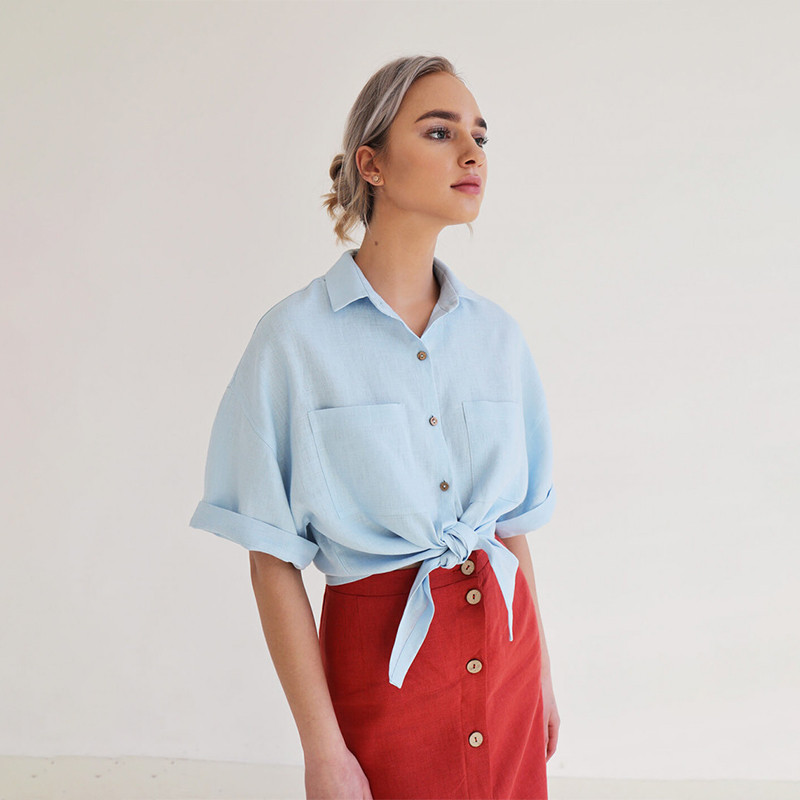
Linen shrinkage is not a fabric defect and it is not unpredictable. It is a measurable, mechanical response of flax fiber to water, and once a buyer understands the two processes behind it, relaxation shrinkage and wet-processing shrinkage, it becomes one of the easiest quality parameters to control in a custom clothing program. The number every linen buyer should start from is the one we quote at LINENWIND, a Dongguan linen clothing factory with 20+ years of OEM and ODM experience: pre-shrunk linen carries a first-wash shrinkage of 3-7%, and that band is achieved by upstream fabric preparation, not by consumer caution. This guide explains shrinkage control from the manufacturing side: why flax shrinks at fiber level, where shrinkage is created and removed across the production chain, which pre-shrink processes actually work, how the 3-7% band is tested and enforced under AQL 2.5, and what a brand should put in the tech pack so sampling and bulk match the same standard. For the complementary question of what a consumer can do after purchase, our answer on how linen manufacturers control shrinkage and colorfastness walks through the testing sequence from the factory side.
Most of what is written about linen shrinkage online is aimed at the end consumer: wash in cold water, do not machine-dry, expect some change. That advice is fine for a finished garment, but it treats shrinkage as something to live with rather than something to engineer out. For a brand placing custom orders, the perspective has to be different, because the shrinkage behavior of a garment is largely decided before the fabric is cut: by the yarn and weave construction, by whether the fabric has been relaxed and pre-shrunk before cutting, and by the wash and drying method used in testing and in the care instructions printed on the label. A factory that controls those stages can ship a garment whose first wash moves inside a predictable 3-7% band; a factory that skips them passes the problem to the end user and, eventually, to the brand in the form of returns and chargebacks.
This guide is written for buyers, founders and sourcing managers evaluating linen manufacturers, so it stays at the level of process decisions a buyer can specify, verify and hold a supplier to. Section 4 covers the actual pre-shrink processes used on linen, Section 5 explains the test methods behind the 3-7% figure, and Section 6 lists exactly what to write into a tech pack. Where a number belongs to our factory, it is stated as our number; where a behavior is general textile mechanics, it is described in standard industry terms, and we have not invented statistics, customer cases or certification details anywhere in this article.
Why Linen Shrinks: What Happens Inside the Fiber
Shrinkage in linen starts with a property of the flax fiber itself: flax is strongly hydrophilic, meaning it absorbs water readily and swells as it does so. A single flax fiber can absorb a significant share of its own weight in moisture, and when the fiber swells in cross-section, the yarns spun from it behave differently than they do when dry. This is the physical root of everything else in this guide, and it explains why linen behaves unlike synthetic fibers, which absorb almost no water, and why shrinkage control has to happen at the fabric and garment stage rather than being talked away at the retail counter.
The classic way to picture it is with the yarn geometry inside the weave. During spinning, weaving and finishing, yarns are held under tension and the woven structure is set while the fabric is stretched on machines. When the fabric is later wetted, the flax fibers swell, the yarns gain volume and lose some of their imposed straightness, and the weave contracts toward a more relaxed, lower-energy state. The fabric gets shorter and, usually, slightly narrower because the yarns that were stretched straight are now following a more crimped path. This is the mechanism behind what textile engineers call relaxation shrinkage, and it is the dominant component of the change a buyer sees after the first wash of a pre-shrunk linen garment.
Why the first wash shows the most change: a properly pre-shrunk linen has already been wetted, relaxed and dried in the factory, so most of the tension-driven contraction has already happened before cutting. What remains for the consumer's first wash is the residual relaxation plus a smaller consolidation effect as the yarns and weave settle into their final geometry. This is why the 3-7% band we quote is a first-wash number: subsequent washes move progressively less, and the dimensional change stabilizes after a few cycles rather than continuing indefinitely.
Two further fiber-level facts shape how much a given linen will shrink. First, the amount of twist and tension locked into the yarn matters: a tightly twisted, highly tensioned yarn has more stored energy to release on wetting than a soft, relaxed one, which is why fabric construction, not just fiber quality, determines shrinkage behavior. Second, the weave density matters: a densely woven fabric has less room for the yarns to move, so its dimensional change is generally smaller and more predictable than an open, loosely woven structure. Neither fact is a reason to avoid linen; both are reasons the fabric specification, including construction and finish, belongs in the order file before sampling begins.
Relaxation Shrinkage vs Wet-Processing Shrinkage: Two Different Problems
Textile technicians separate linen shrinkage into two families, and the distinction is useful for buyers because the two types are controlled at different stages and by different people. Confusing them is the most common reason a shrinkage complaint is aimed at the wrong supplier.
| Comparison Point | Relaxation Shrinkage | Wet-Processing Shrinkage |
|---|---|---|
| Cause | Tension and stretch locked into yarns and weave during spinning, weaving and finishing are released when the fabric is wetted | Additional consolidation caused by mechanical action and heat during wet processes such as dyeing, washing or garment processing |
| When it appears | Mainly in the first wetting and washing of the fabric or garment | During each wet process, which is why garment dyeing adds a shrinkage event after sewing |
| Where it is controlled | Fabric stage: relaxation washing, tensionless drying, compaction before the fabric is cut | Process stage: pre-shrunk fabric entering wet processes, controlled bath temperature and mechanical action |
| Who controls it | Fabric mill and the garment factory's fabric preparation | The garment factory and its dyeing or washing partners |
| Typical buyer experience | The garment is shorter after the first home wash | Additional change after processing steps; visible on garment-dyed or heavily washed programs if preparation was skipped |
The two families overlap in a finished garment, which is why the useful question is never "does this fabric shrink?" but "has this fabric been relaxed and pre-shrunk, and what residual change remains?"
Wet-processing shrinkage deserves special attention in custom linen programs because linen goes through more wet stages than most natural fabrics: scouring and bleaching at the mill, dyeing for colored programs, washing and softening in finishing, and, for garment-dyed styles, a full dye bath after the garment is sewn. Every one of those wet stages is an opportunity for the fabric to consolidate, and every one is also an opportunity to control the outcome if the fabric entered the stage already relaxed. This is the logic behind the factory rule that pre-shrink preparation happens before cutting, not after: once a garment is cut and sewn, its dimensions are committed, and no later process can fully recover a length that was never allowed to stabilize. For dyeing-related shrinkage behavior across the three main routes, our guide to yarn-dyed, piece-dyed and garment-dyed linen explains why garment dyeing in particular requires pre-shrunk fabric before the sewing stage.
Where Shrinkage Is Created Across the Production Chain
Shrinkage is not created in one place; it is accumulated across stages, and each stage either adds tension that will later be released or removes it. Walking the chain from fiber to finished garment shows exactly where a factory earns its shrinkage control:
- Spinning. Yarn twist and spinning tension store energy in the yarn. Higher twist yarns are stronger and crisper but carry more potential relaxation; the spinner's choice of twist level is a fabric-level decision made long before the garment exists.
- Weaving and knitting. Looms run the warp under high tension and set the pick density. A fabric that leaves the loom stretched and set under tension will contract when finally wetted, which is why greige fabric is not dimensionally stable regardless of how good the flax is.
- Mill preparation. Scouring, bleaching and any mill-level dyeing wet the fabric and can partially relax it, but only if the subsequent drying and finishing are done under controlled, low-tension conditions. Drying a wet fabric on a stretched stenter frame can re-introduce exactly the tension that wetting removed.
- Finishing. This is where pre-shrink preparation belongs: relaxation washing followed by tensionless drying, compaction on a compressive shrinking machine where the fabric construction allows it, and moisture control before the fabric is rolled and shipped.
- Garment factory receiving. The cutter should confirm whether the received fabric is pre-shrunk or greige-finished, because the two require completely different handling. Pre-shrunk fabric is cut directly; fabric that still carries residual shrinkage must either be pre-treated or flagged to the buyer before cutting.
- Cutting and sewing. Once cut, the garment pattern dimensions are fixed. Seam type, stitch density and the direction of cutting relative to the fabric grain all influence how the finished garment responds to washing, which is why a spec-conscious factory checks shrinkage before committing the pattern, not after.
For a brand, the practical consequence is that shrinkage control is a property of the whole supply chain, and the garment factory is the right place to hold the standard, because it is the stage that receives the fabric, verifies its behavior and cuts the garment. This is also why our answer on how LINENWIND controls fabric shrinkage and quality starts with fabric receiving and verification rather than with sewing: the decision window closes at the cutting table.
How Factories Pre-Shrink Linen: The Processes That Work
Pre-shrinking is the umbrella term for wetting the fabric, letting it relax, and drying it without re-imposing tension, so that the dimensional change that would otherwise appear in the consumer's first wash happens in the factory instead. The three process families used on linen apparel fabric are worth knowing by name, because they appear in supplier capability discussions and in technical specifications:
- Relaxation washing and tensionless drying. The fabric is washed or batched in water, often with a mild wetting and relaxation stage, then dried in a machine that lets the fabric move freely, such as a tensionless dryer or a relaxed conveyor dryer, rather than pulling it tight over cans or a stenter. This is the most common pre-shrink route for woven linen apparel fabric, and it removes the majority of relaxation shrinkage when done correctly.
- Compaction, sometimes called compressive shrinking. The wet or conditioned fabric is passed through a compressive shrinking machine, typically a sanforizing-type unit, which physically compresses the fabric structure in length to a controlled, lower-shrinkage state. Compaction is widely used where tight dimensional tolerances matter, and it can be applied to linen and linen-rich fabrics with the right machine setup and moisture control.
- Garment-stage washing. For garment-dyed and washed programs, the finished garment is washed or dyed and then dried in a relaxed state, which consolidates the garment as a whole. This stage only works if the fabric entered it pre-shrunk or partially stabilized; washing a garment cut from unrelaxed greige fabric produces exactly the surprise shrinkage brands fear, because the garment is already sewn when the contraction happens.
Three process details separate factories that control shrinkage from factories that only claim to. The first is drying tension: a relaxation wash is wasted if the fabric is dried on a machine that stretches it back out, so tensionless drying is part of the process, not an option. The second is moisture management: linen's dimensional response to moisture means the fabric should be finished and stored at a controlled moisture level, because bone-dry and damp linen measure differently and can shift after cutting. The third is verification: the pre-shrink process is only as good as the wash test that follows it, and a factory should be able to show the first-wash result of the actual fabric lot, not a generic data sheet. For the finishing techniques that sit alongside pre-shrinking, our buyer's guide to washed, enzyme and stone-washed linen covers how wash finishes interact with the pre-shrink stage, and the wider guide to linen fabric finishing methods maps the full sequence.
What "pre-shrunk" does not mean: it does not mean zero shrinkage. Flax is a natural fiber, and a completely dimensionally inert linen fabric would have to be so heavily processed or blended that it would lose the character buyers want. Pre-shrunk linen means the fabric has been relaxed so that its residual first-wash change falls inside an agreed band, 3-7% at our factory, and that the band is verified by testing. Any supplier promising a hard zero on 100% linen is either over-processing the fabric or not testing it; ask for the wash test record instead.
Testing Shrinkage: The 3-7% Band and How It Is Verified
Shrinkage is only meaningful when it is measured against a defined method, because the result depends on how the sample is washed and dried. The internationally recognized reference methods for domestic-laundering dimensional change are the ISO 6330 series, which specifies domestic washing and drying procedures for textile testing, and AATCC 135, the corresponding American standard for dimensional changes after home laundering. Both work on the same principle: the sample is marked with reference points at a defined spacing, washed and dried under a specified program, and re-measured, and the change is reported as a percentage of the original dimension, separately for length and width. A buyer does not need to run the test; a buyer needs to know which method the supplier uses, because "shrinkage 5%" without a method is not a complete specification.
At LINENWIND the shrinkage standard is quoted as a first-wash result of 3-7% on pre-shrunk fabric, and the verification happens in three places. First, at the fabric stage: when a fabric lot is received or selected from our stock library of 50+ linen specifications, its construction is confirmed and its shrinkage behavior is checked before the fabric is committed to a program. Second, at the counter sample: every sample we make in the 7-12 day sampling window is washed and measured for dimensional change, so the buyer sees the actual number for the actual fabric, seam construction and finish before approving bulk. Third, at bulk: production is inspected under AQL 2.5, and dimensional conformance is part of the inspection criteria, with garments measured against the approved sample so that the cut, make and finish stay inside the agreed standard across the whole order.
- Ask for the method: request the wash and dry program used (ISO 6330 or AATCC 135, and which cycle), so the number is comparable across suppliers.
- Ask for the washed sample: the counter sample should be washed and re-measured before approval, because an unwashed sample cannot show shrinkage behavior.
- Ask for length and width separately: linen can shrink differently along the warp and weft, and garments are affected differently by each direction.
- Ask how the number was reached: one test on one swatch is a data point; the standard is confirmed across the lot and monitored during bulk under AQL 2.5.
Because fabric represents roughly 30-45% of garment cost and labor another 25-35%, shrinkage failures are expensive in both materials and rework, which is why the test happens before bulk rather than after a complaint. It is also why our FAQ on shrinkage and colorfastness control treats the two together: both are verified on the washed counter sample, both are locked before bulk, and both are covered by the same inspection discipline.
What Buyers Should Specify: Tech Pack Notes and Design Allowances
Shrinkage control is a partnership: the factory controls the fabric and process, and the buyer controls the specification and the design allowances. Both sides have concrete jobs, and writing them down prevents the most common disputes.
On the specification side, the tech pack should state a maximum first-wash shrinkage with the test method, for example "first-wash dimensional change within 3-7% tested per ISO 6330, cold wash, line dry," and it should ask the factory to confirm the number on the washed counter sample before bulk approval. The pack should also state whether the program requires pre-shrunk fabric, which matters for garment-dyed styles, and it should name the wash method the end consumer will be told to use, because the care instruction and the test method should not contradict each other. If the brand plans to machine-dry in the consumer phase while the factory tests line-dry, the two numbers will differ, and the spec should reflect the stricter scenario.
On the design side, allowances absorb the residual shrinkage that even a well-controlled natural fiber retains. Standard practices include building a small length tolerance into graded patterns for styles where length matters, such as trousers and dresses, confirming inseam and hem allowances against the measured first-wash result, and checking that the pattern direction follows the fabric's more stable direction where the design allows it. These are normal pattern-engineering steps, and a factory with linen experience will raise them during the tech pack review rather than after sampling, because the same garment in the same fabric can fit differently after washing depending on how the allowances were set.
The buyer's pre-order checklist: confirm the fabric is pre-shrunk or agree which stage will pre-shrink it · specify the maximum first-wash shrinkage and the test method · review the washed counter sample and its measured result · agree the care label instruction (wash temperature, drying method) so it matches the test · confirm bulk garments are measured against the approved sample under AQL 2.5. If the program uses blends, note that the second fiber changes behavior: our guides on linen-rayon blend shrinkage and linen-tencel blends explain why blended fabric should always be tested on the real construction rather than assumed from the pure-linen number.
Two care-label implications complete the picture. First, the label is part of the shrinkage system: a garment that is tested cold-wash line-dry should not carry a label that invites hot washing and machine drying, because the label and the test define the same promise. Second, the honest framing sells better than the magical one: brands that tell customers that natural linen relaxes and softens over the first washes, and give one clear care instruction, report fewer fit complaints than brands that promise a fabric that behaves like polyester. For the full set of what to print on a linen garment label, from fiber content to care symbols, our upcoming care-label guidance covers the compliance side; the dimensional side is simply this: state the wash and dry method, and make sure the factory tested to it.
Frequently Asked Questions
Is it normal for 100% linen to shrink in the first wash?
Yes. Flax fibers relax when wetted, so a first wash normally produces some dimensional change. On pre-shrunk linen the change sits inside the 3-7% band we quote, with the largest part appearing in the first wash and progressively less in later washes as the fabric settles. A garment cut from fabric that was never pre-shrunk can move noticeably more, which is why the fabric decision precedes the garment decision.
Why does my linen garment shrink more than the quoted 3-7%?
Three causes cover almost every case: the fabric was not pre-shrunk or was dried under tension at the mill, the garment went through an extra wet process such as garment dyeing without pre-shrunk fabric entering it, or the care method was much harsher than the test method, typically hot water or aggressive machine drying. The fix on the supply side is to specify pre-shrunk fabric and review the washed counter sample; the fix on the care side is to follow the wash and dry method the garment was tested to.
What is the difference between relaxation shrinkage and shrinkage from washing?
Relaxation shrinkage is the release of tension locked into the yarns and weave during spinning, weaving and finishing; it appears when the fabric is first wetted. Wet-processing shrinkage is additional consolidation caused by the mechanical action and heat of wet processes such as dyeing or garment washing. Relaxation shrinkage is removed at the fabric stage by pre-shrinking; wet-processing shrinkage is managed by making sure pre-shrunk fabric is the only fabric that enters further wet stages.
Can a linen factory guarantee zero shrinkage?
Not honestly on 100% linen. Linen is a natural fiber with a real dimensional response to water, and a guaranteed zero would require over-processing that changes the fabric's character, or it would simply be untrue. The professional standard is an agreed, tested band, 3-7% first-wash at our factory, verified on the washed counter sample and monitored in bulk under AQL 2.5. Ask for the test record; it is worth more than a verbal promise.
Does washing linen in cold water and air-drying prevent shrinkage?
It prevents additional shrinkage beyond the fabric's tested behavior, and it is the right care instruction for most linen. The residual relaxation that remains after factory pre-shrinking will still appear in the first wash, which is normal and expected within the 3-7% band. Cold, gentle washing and line drying keep the change to the tested minimum; hot water and machine drying add mechanical and thermal energy that pushes the fabric past its tested state.
Do linen blends shrink less than 100% linen?
Not automatically. Blends behave according to the second fiber and the construction: some fibers reduce shrinkage and add dimensional stability, while others change the response in other ways, and every blend should be tested on the actual construction. The 3-7% figure we quote is for our pre-shrunk linen programs, and blended programs are quoted and tested on their own numbers. Our guide to linen-rayon blend shrinkage shows how much the second fiber changes the answer.
What shrinkage test should a brand ask the factory to run?
Ask for a domestic-laundering dimensional change test on an internationally recognized method, in practice ISO 6330 or AATCC 135, with the wash program and drying method stated, reported as length and width percentages. Ask that it be run on the counter sample in the 7-12 day sampling window and washed before approval, and that bulk conformance be checked under AQL 2.5 against the approved sample. That combination turns shrinkage from a post-delivery surprise into an agreed, verified specification.
Why does garment-dyed linen need extra shrinkage care?
Because garment dyeing adds a full wet process after the garment is sewn, and a garment cut from unrelaxed fabric will consolidate in the dye bath when its dimensions are already committed. The control is upstream: pre-shrunk or compacted fabric enters the cutting room, and the counter sample is washed, measured and shade-approved before the dye recipe is locked. Our dyeing guide covers the garment-dyeing route and its shrinkage controls in detail.
Linen shrinkage control is the clearest example in apparel manufacturing of a quality parameter that is decided upstream and only measured downstream. Understand the two mechanisms, relaxation and wet processing; confirm the fabric is pre-shrunk by a real process with tensionless drying; test the counter sample on a recognized method and keep the 3-7% band honest; and let design allowances absorb the small residual that a natural fiber keeps. A brand that does those four things will find linen's dimensional behavior a solved problem, not a recurring complaint, and the garments will arrive, wash and fit as specified, from the first order to the reorder. If you are planning a custom linen program and want the shrinkage standard agreed before sampling, send us your tech pack with your target specification, and our team will confirm the fabric, wash-test the sample and quote within 48 hours through the contact page or by sending an inquiry.