Linen Loungewear and Sleepwear: Pajama Sets, Robes and Relaxed Separates
- Share
- publisher
- LINENWIND
- Issue Time
- Sep 16,2026
Summary
Linen loungewear and sleepwear as a manufacturing category: fabric weight and weave by piece, sleep blocks and ease distribution, waistband, elastic and drawstring construction, robe collars, belts and pockets, softening finishes, dye and blend routes, sizing and SKU planning for set programmes, sampling with wash tests, QC at AQL 2.5, and the cost, MOQ and lead-time picture. From LINENWIND, a Dongguan linen garment manufacturer, MOQ 60 pcs per style per colour.
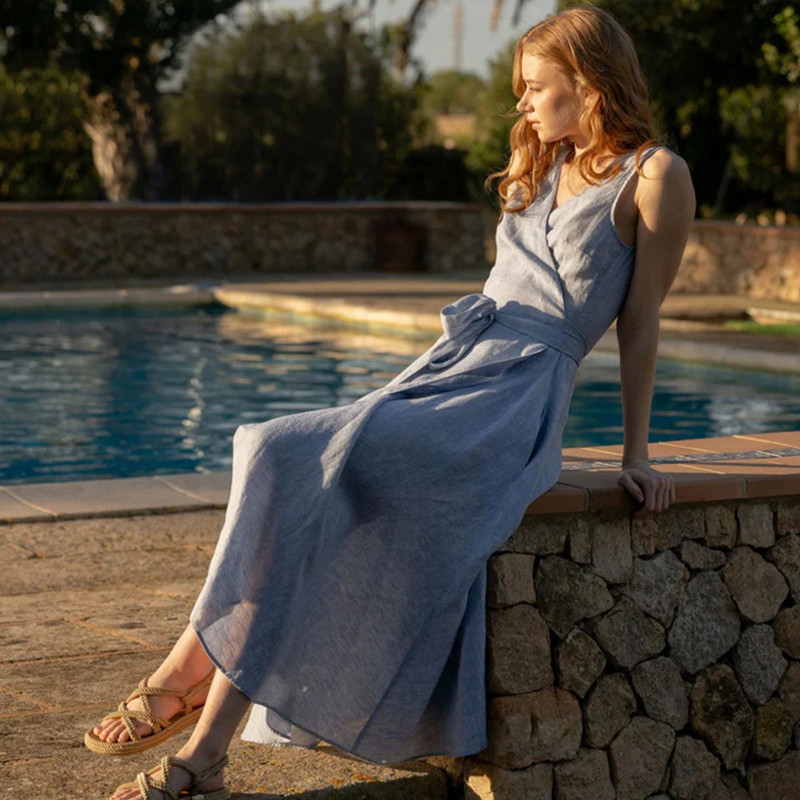
Linen loungewear is where a brand's customers spend the most private hours of their day, and it is the last category most brands learn to manufacture properly. The pieces look simple. A pajama set is two rectangles and a waistband, a robe is a long shawl-collar wrap, and relaxed separates are a soft pant with a matching top. In production, though, sleepwear is unforgiving in ways that a shirt is not. The garment is worn against bare skin for eight hours, it is washed more often than any other linen piece in the wardrobe, it is judged entirely by hand feel and by how it settles on the body rather than by how it holds a line, and every seam, elastic and label is felt rather than seen. This guide covers linen loungewear and sleepwear as a manufacturing category rather than a marketing one. It sets out which fabric weights and weaves suit pajama sets, robes and relaxed separates, how sleepwear blocks are cut, the construction details that matter in sleepwear (waistbands, encased elastic, drawstrings, flat seams, closures), robe construction, the softening and finishing routes that make linen comfortable at night, colour and blend options including linen-viscose and linen-Tencel, how to plan sizes and SKUs for a set programme, sampling and shrinkage control, quality control at AQL 2.5, and the cost, MOQ and lead-time picture. The figures are the ones we publish: MOQ 60 pieces per style per colour, counter samples in 7-12 days with a realistic window of 7-14 days, bulk production in 25-35 days, a first order of roughly 35-60 days, fabric weights across roughly 100-260 GSM, first-wash shrinkage held to 3-7 percent, and AQL 2.5 inspection. Linenwind is a Dongguan linen garment manufacturer with more than 20 years of OEM and ODM experience for European and North American brands. If you are still deciding where sleepwear sits in your range, our analysis of why linen loungewear is growing in global fashion markets covers the demand side, and the wider category map is in the FAQ on what types of linen clothing can be manufactured. The first thing a brand notices when it moves from linen shirts into linen sleepwear is that the same factory, the same cloth and the same measurements produce a garment that feels wrong. The measurements are usually not the problem. Four properties of sleepwear change what the pattern and the construction have to do. The fabric is selected for skin contact, not for structure. A daytime linen shirt is often chosen for how it holds a collar or a cuff; sleepwear is chosen for how it feels after twenty washes against the ribcage and the inside of the arm. That pushes the specification toward lighter weights, softer finishes and, in many programmes, a blend. It also means that a fabric which passes a daywear hand-feel approval can still fail a sleepwear wear-test after three wash cycles, because the surface gets rougher and the cloth firms up as the finish washes out. Every internal edge becomes a tactile event. In a shirt, a serged seam allowance inside a side seam is invisible and irrelevant. In a pajama top worn directly on the skin, that same seam sits over the waist and is felt all night. The same is true of a care label stitched into a side seam, a scratchy woven brand label at the back neck, a hard elastic edge at the waist, a metal eyelet on a drawstring channel and a heavy button at the front placket. Sleepwear construction is largely the discipline of removing or relocating those events. The garment is washed far more often than it is worn out. A linen shirt might be dry-cleaned or worn twice between washes; sleepwear is washed after every wear, which is why a sleepwear programme's first-wash shrinkage, colour retention and seam stability test results matter more than its abrasion results. A 3-7 percent shrinkage figure that is acceptable in a shirt becomes visible in a pajama set, because the pants get shorter and the top gets narrower at the same time, and the customer notices the set no longer covers the ankle the way it did on day one. The fit is meant to be loose, which removes the crutch that fit normally provides. A tailored garment hides a slightly wrong grain line or a marginally short seam allowance inside a close fit. A relaxed pajama pant with a 4 cm ease margin has nothing to hide behind: if the side seam twists, if the waistband is not balanced, if one leg is cut a few millimetres off grain, the garment hangs visibly crooked. Softness in sleepwear is a construction result, not a size decision. Approve sleepwear after washing, not before. A pajama set should be judged on the third wash: hand feel, shrinkage across both pieces, label comfort, elastic recovery and colour retention together. Sleepwear is not one fabric specification. The three product groups in a typical linen lounge range are worn in different conditions, cut on different blocks and washed at different frequencies, so the cloth is selected per piece rather than per collection. Our general reference on choosing the right linen GSM covers the structural logic of weight; the table below applies it to sleepwear. GSM ranges are working manufacturing ranges from our own fabric library, which holds more than 50 in-stock linen specifications. Exact available weights depend on the weave, the fibre origin and the finish. Three practical rules follow from the table. First, never use one cloth across the whole range unless it is the mid-point: a 150 GSM plain weave will make a heavy summer short and a flimsy winter robe, so programmes that want a unified hand should standardise on the blend and the finish rather than on the weight. Second, robes are the piece where brands most often under-specify, because a light robe feels lovely in a showroom and looks thin in a bathroom mirror. Third, if the programme will be sold in two seasons, the same style is usually produced in two weights rather than in two fabrics, which keeps the block, the trims and the size grading unchanged. Sleepwear silhouettes look forgiving and are not. The relaxed cut is exactly what exposes a bad block, because there is no fit tension to correct it. A linen loungewear block is normally developed from the brand's daywear block with four deliberate changes. The silhouettes that carry a linen sleepwear range are consistent across markets: a straight-leg or gently tapered pajama pant, a boxy or camp-collar pajama top, a short kimono and a long belt-tied robe, an elasticated wide-leg lounge pant, and a relaxed short with a covered waistband. The pieces that cause trouble are the ones borrowed from daywear - a fitted shirt as a pajama top, or a narrow-leg pant. Both fight the cloth: a fitted shirt pulls across the chest when the wearer turns in bed, and a narrow linen pant twists at the knee. If a brand wants a tailored look in loungewear, the better route is a slightly heavier cloth and a straighter leg, as described in our manufacturing guide to custom linen trousers and chinos, rather than a tighter version of a sleep block. Most of the difference between a sleepwear garment that customers reorder and one that gets returned is found in about 30 centimetres of waistband and 40 centimetres of placket. These are the details we specify with brands before the first sample, and the ones that determine how a set is priced. The sleepwear placket is usually a simple two-fold front with three to five buttons, and the button choice matters more than the button count: a flat four-hole button in a natural material is comfortable, while a thick shanked or metal button is not. Sleeve cuffs are normally a simple turned hem with a single row of stitching rather than a shirt cuff, because a cuff band is an extra layer against the wrist. Side seams and shoulder seams are pressed open and, in the best sleepwear, closed with a flat fell or a French seam so no raw allowance can touch the skin; where a serged finish is used, the allowance is trimmed narrow and pressed to the back. Neck labels are woven, soft-edged and stitched at two points only, or printed directly on the inside back, and care labels are positioned so they can be removed. Hardware is kept to a minimum: no metal eyelets at the neck, no metal cord ends, no hooks in the channel. Sleepwear is the one category where a lower-spec construction usually reads as a comfort failure rather than a quality failure. Flat seams and a balanced elastic channel cost fractions of a cent and decide whether a set is reordered. For brands building a set programme rather than single pieces, the top and the pant must be developed together: shared cloth, shared wash, shared trims, matched colour and matched shrink behaviour. Our overview of linen set manufacturing describes how that pairing is handled at the supplier level, and the same logic is used here. A robe is the most demanding piece in a linen lounge range because it has no lining, no closures and no fit tolerance. It is a single layer of cloth that must cover the body, stay closed when belted, hold a collar that stands up, and drape without collapsing at the shoulders. Four construction decisions carry the whole garment. The first is the collar. A shawl collar is cut as one piece with the front, folded back and topstitched along the fold, which gives the roll that a linen robe needs to look intentional; a set-in collar band behaves like a shirt collar and does not have the volume for a wrap front. The collar edge is the part that shows most in product photography, so the fold line and the topstitch spacing are approved on the sample rather than in the specification. The second is the belt and the belt loops. The belt is usually self-fabric, cut on the straight grain and interfaced lightly at the centre so it does not curl, with belt loops set at the side seams and 6-8 cm back from them. Loop placement is decided with the sample on a body, because loops positioned from a flat pattern land in the wrong place on a belted robe. The belt is the piece most likely to be lost, which is why many programmes include a thread chain to hold it. The third is the pockets. Patch pockets on a linen robe are set with a narrow turned edge and a topstitch that follows the hem line, and they are placed below the belt so that the belt does not run across the pocket mouth. Inset pockets are rare in linen robes because the cloth is too lively to hold a clean welt, but a simple in-seam pocket works on the kimono wrap. The fourth is hem depth and finish. Robes are cut with a deeper hem than a shirt, typically 3-4 cm, because a heavier robe hangs better with weight in the hem and because a deep hem can be let down if the first wash takes more length than the allowance predicted. The hem is a single turned fold or a folded band rather than a rolled edge, and the sleeve hem matches it. A robe is also the piece where the fabric decision is most visible. Because there is no lining and no second layer, the cloth supplies everything, which is why robes generally sit at the heavier end of the sleepwear range and why brands that want a light robe for a warm-climate market should choose a gauze or a blend rather than simply cutting the pajama cloth longer. Raw linen off the loom is not sleepwear. It is crisp, slightly stiff and has a surface that catches on itself. The step that turns it into a garment a customer wants against their skin is the finish, and the finish is also what determines how the piece reads on the third wash and after a year. Choosing a finish is a purchasing decision with a cost and a risk attached, and it is best made before the sample rather than after the wear test. Our buyer's guide to washed, enzyme and stone-washed linen finishes compares these routes on hand feel, cost and durability in more detail. For sleepwear, two rules matter most. First, the finish must be applied to the fabric before cutting, not to the finished garment, so that both pieces of a set shrink together and the seam stability is tested on the same cloth the bulk will use. Second, the finish has to be specified in the sample approval as a measurable property - hand feel reference, wash cycle and result - otherwise the bulk can pass the sample comparison and still feel different on the third wash. Sleepwear colourways tend to be quieter than daywear, which sounds easier and is not. Pale, neutral and undyed-looking colours are exactly the shades where a colour difference between the top and the pant of a set, or between two bulk lots, is most visible. Three routes are used, and the choice affects both the sample calendar and the minimum quantity. On fibre, 100 percent linen is the purist specification and the one that carries the category's story. Blends are a commercial decision as much as a comfort one. A linen-viscose or linen-Tencel blend drapes more fluidly, resists creasing in the night and softens faster, which makes it very effective in pajama sets and lounge pants; a linen-cotton blend is cheaper and more stable but loses some of the breathability story; a linen-silk blend belongs in premium robes. Our comparison of linen-Tencel blend fabric sets out the ratio guidance and the cost effect, and the same logic applies to viscose. In a sleepwear programme we normally develop the hero set in 100 percent linen and one or two volume styles in a blend, so the range has both a story and a price ladder. Colour consistency inside a set matters more than absolute colour accuracy. Approve the top and the pant as a matched pair under the same light, and write the tolerance into the specification in numbers, not adjectives. A set doubles the size problem. Two garments have to fit the same customer at the same time, and the two are usually sold as one unit, so a brand cannot hide a short sleeve or a long pant behind a separate size choice. Sleepwear is also where extended sizing shows up first, because the comfort argument applies to every body type. The practical approach is to grade the pant and the top from one block family with one size run, so that a size M top is designed for the same body as a size M pant, and then to check three points on the fit sample: the waistband at rest and extended, the rise relative to the natural waist, and the top length when the arm is raised. In our experience the failures in a sleepwear set are almost always in the waistband and the rise, not in the chest measurement, because a loose top forgives a great deal and a waistband forgives nothing. Size runs for European and North American sleepwear are usually XS-XXL or S-3XL, with unisex styles running on men's grading and a narrower women's block. Two commercial points are worth deciding early. First, whether the set is sold as a single SKU with a fixed size combination or as mix-and-match sizes, since mix-and-match multiplies the variants and the packaging but reduces returns. Second, how many colourways the programme carries: a sleepwear range of one silhouette in three colours with two size runs is nine variants, and each variant has its own minimum, which is why sleepwear programmes are usually built around a small number of hero styles rather than a wide assortment. The documents that make this manageable are the ones a brand supplies at the start rather than after sampling. A specification pack with the size chart, measurement points and tolerances, garment measurements by size, trim and label list, colour references and packing instructions removes most of the ambiguity from a set programme; our tech pack guide covers what each page has to contain. The FAQ on developing linen garments from sketches or tech packs explains what a factory can develop from an incomplete brief and what it cannot. One further SKU decision is packaging. Sleepwear is increasingly sold as a gifting piece, which pulls folded presentation, a tissue wrap, a hangtag and sometimes a reusable pouch into the specification. Those items are cheap individually and expensive collectively, and they add a procurement step that must be planned at the same time as the labels rather than after production. Sleepwear sampling has a different purpose from daywear sampling. Nobody is proving that a collar stands up; the brand is proving that the set is comfortable, that the two pieces match after washing and that the waistband behaves. That changes the sample protocol. We develop counter samples in 7-12 days per style, with a realistic window of 7-14 days when the cloth has to be sourced or a blend has to be woven. For a sleepwear set, we recommend that the sample round includes three pieces of evidence beyond the garment itself. The first is a wash test: the sample is washed on the agreed cycle and re-measured, with the shrinkage recorded per measurement point, because a set that shrinks 5 percent in the pant and 3 percent in the top will look mismatched at the hem. The second is a wear check on the inside: a fit model should report on the waistband edge, the label position, the seam feel at the side and the placket when lying down. The third is a trim check, with every label, cord end, button and packaging item present on the sample, because sleeping garments are approved as a physical object and a missing label is discovered at the bulk inspection. Our article on linen clothing lead times sets out how the sample round fits into the shipping calendar. Shrinkage is handled in three places at once: the fabric is pre-shrunk before cutting, the pattern carries an allowance based on the measured shrink figure for that cloth, and the finished garment is measured against a spec that was written with that allowance already applied. The published working figure for linen is a first-wash shrinkage of 3-7 percent, and the number used for a specific order is the one measured on the sample cloth. Writing the allowance into the pattern rather than into the sample reading is what keeps a reorder the same size as the first order. Sleepwear defects are not the same defects a buyer looks for in a shirt. A sleepwear garment can pass a standard visual inspection and still be uncomfortable, so the inspection checklist for this category adds comfort and structure points to the usual workmanship checks. We inspect finished loungewear at AQL 2.5, the working standard for apparel that is described in detail in our guide to linen garment quality inspection. Defects found in-line are corrected in-line rather than at final inspection: the waistband is the clearest example, since a twisted elastic cannot be fixed after the channel is closed and the whole garment has to be rebuilt. Findings of any critical defect stop the lot. Linen sleepwear sits at the simple end of garment construction, which surprises brands when the quote arrives: a pajama set often costs more per unit than a linen shirt. The reason is that most of the cost is not in the making, it is in the fabric and in the finishing, both of which sleepwear uses generously. In our cost model, fabric accounts for roughly 30-45 percent of the unit cost and labour roughly 25-35 percent, with the balance made up of trims, finishing, testing, packaging and overhead. Four things move the price of a sleepwear programme. Our published figures are stable across the category: a minimum of 60 pieces per style per colour, counter samples in 7-12 days with a window of 7-14 days, bulk production in 25-35 days from approved sample and deposit, a first order including sampling and shipping completing in 35-60 days, sample fees of USD 40-150 per style fully refundable against the bulk order, and free swatches. Quotes are issued within 3-7 working days of a complete brief, with an initial response within 48 hours. Sleepwear sits in the middle of the bulk window: less internal work than tailored outerwear, more finishing and washing than a plain top. Payment is normally structured at 30 percent deposit with the balance against the bill of lading or before shipment, and the terms behind that structure are set out in our guide to negotiating pricing, MOQ and payment terms. Plan sleepwear around the season, not around the order. A spring lounge launch should start in October: sampling, first-wash approval and bulk production take about six weeks, and sea freight adds 30-45 days before the goods reach a European or North American warehouse. Sleepwear attracts more labelling attention than any other linen category. In the United States, textile fibre content, country of origin and care instructions are mandatory, and sleepwear in particular has flammability rules that apply to children's garments; in the European Union, fibre composition and care labelling follow the same principle of telling the customer exactly what the product is and how to keep it. Our position is straightforward: we manufacture to the brand's specification and supply the fibre composition, care recommendations and test documentation to support it, and the brand's own compliance adviser signs off the final label copy for its market. For linen sleepwear the care recommendation we put forward is conservative and matches the cloth: machine wash cool on a gentle cycle, no chlorine bleach, line dry or tumble low, warm iron while slightly damp, and wash with similar colours for the first few cycles. That last point matters in this category because sleepwear is washed so frequently and because pale linen shades can transfer. Certification evidence is supplied on request: our facility holds ISO 9001 for quality management, OEKO-TEX Standard 100 for the fabrics we use on skin-contact garments, and SEDEX membership for ethical sourcing records, and our article on linen manufacturer certifications explains how buyers verify each one. Packaging for sleepwear is usually decided last and should be decided first. Polybag or recycled paper sleeve, folded with the top visible, tissue interleaving, a hangtag, a branded cotton pouch for gift sets, and a size sticker are all routine; each adds procurement lead time and each has to appear on the sample for the bulk inspection to match. When a programme is being sold as a gift, the packaging is part of the product specification, not a finishing detail. Our work on sustainable manufacturing in custom linen pajamas describes how recycled and mono-material packaging options are specified, and the styles a programme can be built from are summarised in the FAQ on linen clothing styles for loungewear. Most pajama sets are built on 120-160 GSM plain weave or fine twill with a softened finish. Below 120 GSM the cloth can become semi-transparent in pale shades and will not hold a placket or pocket shape; above about 160 GSM the set feels heavy when the wearer turns in bed. Robes run heavier, typically 160-220 GSM, because a robe is a single-layer garment and the cloth supplies all of the body and cover. Our fabric library holds more than 50 in-stock linen specifications, so those weights can usually be sampled without a custom weave. Both work, and the choice is commercial as much as technical. 100 percent linen is the most breathable option and carries the category's sustainability story, but it creases in the night and feels crisp until it has been washed several times. A linen-viscose or linen-Tencel blend drapes more fluidly, creases less and softens faster, which suits pajama sets and lounge pants; a linen-cotton blend is more economical and more stable. Many ranges we produce develop the hero set in 100 percent linen and volume styles in a blend. The channel is cut 4-6 mm wider than the elastic, the elastic is quartered and matched to the quarter points of the channel before stitching, and it is secured through the side seams so it cannot roll. This is a construction requirement rather than a fabric one, and a twisted elastic cannot be corrected after the channel is closed, so the waistband is checked during sewing and again at final inspection. Encased elastic in a self-fabric channel is the most comfortable option for nightwear; a functioning drawstring adds cost but is the detail most buyers choose for a premium set. First-wash shrinkage for linen is normally 3-7 percent, and controlling it is a three-part routine: pre-shrinking or sanforising the fabric before cutting, building the measured allowance into the pattern, and checking the finished garment against a specification that already includes that allowance. For a two-piece set, both pieces are cut from the same pre-shrunk lot and washed on the same cycle so that the top and the pant stay matched. We record shrinkage per measurement point on the approved sample and use that figure for the order. Our minimum is 60 pieces per style per colour, which applies to each piece of a set. A brand launching a pajama set in two colours is therefore looking at 60 pieces per colour for the top and the same for the pant. Because the fixed costs - pattern, block development, sampling, per-style trims - are high relative to the fabric in this category, keeping the range to a small number of hero styles with multiple colours is usually cheaper per unit than a wide assortment. Our minimum order FAQ explains how the manufacturing minimum is calculated. Counter samples are charged at USD 40-150 per style and are fully refundable against the bulk order; swatches are free. Development takes 7-12 days per style, with a realistic window of 7-14 days when the cloth has to be sourced, woven or finished to specification. For a sleepwear set we ask for a wash test and a wear check on the inside of the garment as part of the sample round, so one round usually answers the comfort questions rather than requiring two. See what sampling costs and whether it is refundable. Partly. With a mood board and a target price we can propose cloth, weights and silhouettes and develop the first samples, which is how many boutique ranges start. What we cannot do is compress the decisions that only the brand can make: size grading for the target market, colour approvals, label copy and the split between hero styles and volume styles. A written brief with a size chart and a trim list usually removes one full sample round, and our overview of linen loungewear OEM and ODM programmes describes the information a factory needs at each stage. Linen loungewear is a category where the customer's verdict is delivered in the dark, by hand, after a wash. The fabric weight per piece, the balance of the sleep block, an elastic that stays flat in its channel, a seam that cannot be felt, a robe collar that rolls instead of gaping, a finish that is still soft on the third wash and a set whose two halves shrink together are what decide whether the range is reordered. None of those are expensive decisions, and all of them have to be made before the sample, not after the bulk. Linenwind manufactures linen pajama sets, robes, lounge pants, shorts and relaxed separates from our facility in Dongguan, working to MOQ 60 pieces per style per colour, counter samples in 7-12 days and bulk production in 25-35 days, with fabric weights from about 100 to 260 GSM, first-wash shrinkage held to 3-7 percent and finished-garment inspection at AQL 2.5. If you are building a sleepwear or loungewear programme, send the brief - silhouettes, fabric direction, target market and quantity - and we will come back within 48 hours with a first response and a quotation in 3-7 working days covering cloth options, finishing routes and the calendar. Start with how the minimum order quantity works, review the full range in what types of linen clothing can be manufactured, and then contact us to open the sampling round.Why Sleepwear Is a Different Manufacturing Problem from Daywear
Fabric Weight and Weave by Piece: Pajama Sets, Robes and Relaxed Separates
Piece Working GSM range Weave and hand Why this weight Pajama top and pant (set) 120-160 GSM Plain weave or fine twill, softened wash Light enough to move with the body in bed, heavy enough not to go transparent and to hold a placket and pocket Loose lounge pant 140-190 GSM Plain weave, sometimes with a linen-viscose blend Carries a waistband and elastic without the fabric gathering or rippling along the casing Lounge top and tunic 130-170 GSM Plain weave or slub weave Keeps a relaxed drape while holding a neckline and sleeve head shape Robe and dressing gown 160-220 GSM Heavier plain weave, waffle or twill The robe is a single-layer garment with no lining, so the cloth itself has to supply body, cover and warmth Kimono and short wrap 140-180 GSM Plain weave or gauze for summer Lighter wraps are folded and belted repeatedly, so the cloth must not crease into a permanent line at the belt Relaxed separate short 120-160 GSM Plain weave, soft finish Sits against the thigh with a wide leg opening; weight above 160 GSM makes the short feel heavy when seated Blocks and Silhouettes: Cutting Comfort Without Losing Balance
Sleepwear Construction: Waistbands, Elastic, Drawstrings and Closures
Waistband options for pajama and lounge pants
Closures, seams and skin-side details
Robe Construction: Shawl Collars, Belts, Patch Pockets and Hem Depth
Robe detail Standard specification What goes wrong if it is under-specified Shawl collar One-piece cut with the front, folded and topstitched Collar rolls open, front edge gapes when belted Belt Self-fabric, straight grain, light centre interfacing Belt curls, twists and looks cheap after two washes Belt loops Two loops at side seams plus two 6-8 cm behind Belt slips and the robe opens at the wrap Pockets Patch pockets below the belt line, topstitched Pocket mouth crosses the belt; contents pull the wrap open Hem 3-4 cm folded hem, matched on sleeve Hem flattens, the robe looks longer at the front than the back Cuffs Simple turned hem, single stitch row A banded cuff drags on the wrist and picks up soap in the wash Softening and Finishing: How Factories Make Linen Sleep-Friendly
Colour, Print and Blend Routes for Sleepwear Programmes
Sizing and SKU Planning for a Pajama Set Programme
Sampling, Shrinkage Control and Fit Rounds
Quality Control for Loungewear: What AQL 2.5 Inspection Catches
Cost, MOQ and Lead Time for a Sleepwear Programme
Labels, Compliance and Packaging for Sleepwear
What fabric weight should a linen pajama set use?
Is 100 percent linen or a blend better for sleepwear?
How do you stop the elastic waistband from twisting?
How much does linen sleepwear shrink, and how is it controlled?
What is the minimum order for custom linen loungewear?
What does a linen sleepwear sample cost, and how long does it take?
Can you develop a loungewear range if we only have a mood board?