Linen Hemp Blend: The Sustainable Fabric Combination for Your Next Collection
- Share
- publisher
- LINENWIND
- Issue Time
- Sep 2,2026
Summary
Linen hemp blend fabric explained for B2B buyers: why brands are specifying it, workable blend ratios (70/30, 55/45, 50/50), strength, antibacterial behavior and drape changes, cost and lead time, certification and labeling requirements for industrial hemp, and 3-7% first-wash shrinkage control. MOQ 60, counter samples 7-12 days, bulk 25-35 days.
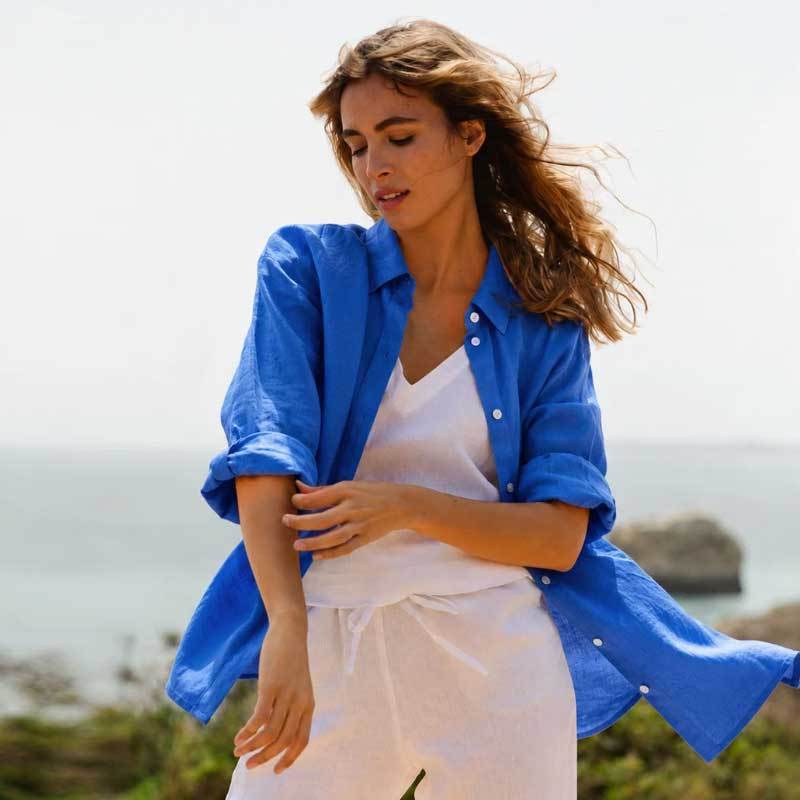
A linen hemp blend combines flax and industrial hemp bast fibers into a woven fabric that is stronger, more durable, and more dimensionally stable than 100% linen, while keeping the natural texture and breathability buyers expect from linen. For fashion brands sourcing custom clothing from China, the practical questions are not whether hemp is "greener" than linen, but which blend ratio to specify, how the fibers behave in cutting and sewing, what the fabric adds to unit cost, and how shrinkage is controlled before bulk production. This guide answers those questions from the factory side, using the production parameters we work with every day at LINENWIND, a Dongguan-based linen clothing manufacturer with 20+ years of OEM and ODM experience: MOQ 60 pieces per style per color, counter samples in 7-12 days, bulk production in 25-35 days, first orders in 35-60 days, and first-wash shrinkage of 3-7% on pre-shrunk fabric. Linen hemp blend fabric sits in a different position than the Tencel blends covered in our linen Tencel blend guide. Tencel softens and adds drape; hemp does the opposite in several ways. Hemp fiber is longer and coarser than flax, which makes a blend stiffer initially, more tear-resistant, and less prone to stretch out of shape. Brands specifying linen hemp blends are usually after a rugged, utilitarian, or outdoor-oriented hand feel, a stronger sustainability story, or garments that survive heavy use, such as workwear, outerwear, bags, and hospitality uniforms. If you are evaluating this fabric for a spring or autumn collection, the sections that matter most are the blend-ratio table in Section 3, the cost and lead-time table in Section 5, and the certification checklist in Section 6. They contain the numbers you need to brief a factory correctly and to avoid the two most common mistakes we see: specifying an unproducible ratio, and assuming a linen hemp blend shrinks like pure linen. A linen hemp blend is a woven fabric made from two bast fibers: flax (linen) and industrial hemp. Both fibers come from the stems of their plants, both are among the oldest textile fibers in use, and both are grown with relatively low water and pesticide input compared with cotton. The two fibers are blended at the spinning stage into a single yarn, then woven on the same looms used for pure linen. Because both are cellulosic bast fibers with similar length and fineness ranges, they can be spun together without the special handling that synthetic-cellulose blends require. Industrial hemp used in textiles is legally distinct from the plant associated with recreational use. Textile hemp contains negligible levels of THC, is grown under licensed agricultural programs in the EU, Canada, China and elsewhere, and the fiber itself is processed identically to flax in scutching and hackling. This distinction matters for compliance: if your brand plans to sell hemp-containing garments in the US or EU, the fiber must come from licensed industrial hemp cultivation, and your factory should be able to state the country of origin of the hemp yarn on the quote. Why are brands asking for it now? Three commercial drivers are visible in the orders we see at LINENWIND. First, the sustainability story: hemp grows quickly, tolerates a range of climates, and requires little irrigation, which supports the environmental narrative of a linen-forward brand without abandoning the linen look. Second, performance positioning: a hemp component measurably increases fabric strength and abrasion resistance, which lets brands sell workwear, travel, and outdoor garments with a defensible durability claim. Third, differentiation: hemp remains rare enough in mainstream linen assortments that a linen hemp capsule reads as deliberate rather than generic. For a broader look at how linen fits into eco-positioned lines, our sustainable linen manufacturing guide covers the wider certification and sourcing landscape. Factory note: In our production experience, a linen hemp blend does not behave like a linen Tencel blend. It is initially stiffer, cuts more cleanly, and holds its shape better, but it requires stronger needles, adjusted stitch density, and careful control of moisture during sewing because hemp yarn is less elastic than flax. None of this is a barrier; it is simply a different set of parameters that should be settled in the sampling phase. There is no single "correct" linen hemp ratio, and the ratio a buyer can actually produce depends on yarn availability, weaving behavior, and the target hand feel. The ratios below are the ones we see most often in custom programs and the garment types they fit. Three production realities should guide your ratio choice: The decision between ratios usually comes down to the garment's use. A relaxed summer shirt works at 70/30, where hemp is an invisible strength upgrade. A work jacket or utility trouser benefits from 55/45 or 50/50, where the rougher hand feel is a feature. We recommend ordering counter samples in two candidate ratios, which is standard practice in our sampling process and costs two sample fees, both fully credited to production. The commercial value of hemp in a blend comes down to three measurable differences from pure linen. Each has a production and a retail consequence that a buyer should be able to explain to their own team. Hemp bast fiber is among the strongest natural fibers, with high tensile strength and low elongation. In a blend, this translates to a fabric that resists tearing, abrasion, and seam stress better than pure linen of the same weight. Garments such as workwear, aprons, and outerwear survive heavy use with less visible wear at cuffs and knees. Hemp is highly absorbent, wicks moisture well, and has naturally occurring antimicrobial properties attributed to the fiber's structure and surface chemistry. In blends, this supports odor-control and freshness claims for activewear, uniforms, and hospitality linen. We recommend describing this as "naturally antibacterial" rather than a lab-verified antibacterial claim unless you commission your own testing. Hemp is coarser and less elastic than flax, so a blend is initially stiffer and drapes with more structure than pure linen. After washing, the fabric softens considerably, but it never reaches the fluid drape of a Tencel blend. Design for the crisp, structured silhouette this fabric wants: tailored jackets, straight trousers, and utility shapes. Hemp also changes how a garment holds its shape in use. Pure linen garments can bag at the elbows and knees over a day of wear because flax has limited elastic recovery. The hemp component improves recovery, which is why 55/45 trousers and uniforms stay presentable longer between presses. This is the property hospitality and workwear buyers notice first, and it is the reason hemp blends are appearing in uniform programs that previously specified pure linen. Color and finishing behave differently too. Hemp takes dye well but at a slightly different rate than flax, so a poorly controlled dye lot can show a subtle two-tone effect. Our dyers run blend fabrics on dedicated programs and inspect every batch against the approved sample, the same discipline we apply to linen Tencel blends. If your brand uses natural or undyed shades, the ecru and oatmeal tones of an unbleached blend are a strong point: the fabric needs no dye at all, which simplifies the environmental story and removes a whole class of color-matching risk. Cost is where the linen hemp story becomes concrete. In our cost structure for custom linen garments, fabric typically represents 30-45% of the total garment cost and labor 25-35%. The hemp component affects both sides of that equation: hemp yarn is generally comparable to or slightly below premium flax yarn in price depending on origin and certification, but the fabric may carry a premium if it requires a custom mill order rather than stock yarn. Lead time depends almost entirely on fabric availability. If the blend ratio and GSM are available from our stock library, a linen hemp program follows the same timeline as any custom linen order: counter sample in 7-12 days, bulk in 25-35 days, first order in 35-60 days. If the ratio requires a custom yarn order from the mill, add the mill lead time, which we quote explicitly before any commitment. This is why we always ask buyers to confirm the ratio early, before sampling, so the yarn question is settled in parallel with pattern development rather than after. The sampling phase is also where shrinkage and colorfastness are verified. We pre-test the blend on the counter sample and confirm the first-wash shrinkage range before bulk, so the garment pattern can be cut with the correct allowance. This is the same discipline as pure linen, and it is the step that prevents the two most common linen hemp complaints at retail: unexpected length shrinkage and seam puckering. Hemp changes your certification and labeling obligations, and this is the area where brands most often get caught. The checklist below reflects what we verify with our fabric and yarn suppliers before quoting a hemp-containing program. Honest positioning: Hemp's environmental story is strong but easy to overstate. "Grown with less water than cotton" is defensible; specific percentages vary by region and season and should not be published without a source. We recommend brands make verifiable claims, such as fiber origin, cultivation licensing, and certification status, and leave comparative statistics out of marketing copy unless they are sourced. For buyers building a compliance file, request three documents with the quote: the fiber origin statement, the OEKO-TEX Standard 100 certificate if applicable, and the shrinkage test report from the counter sample. These three documents cover the legal, the environmental, and the quality dimensions of a hemp program, and they are exactly what your retail buyers or distributors will ask for. Shrinkage is the technical detail that most often surprises brands new to hemp blends. At LINENWIND we quote a first-wash shrinkage range of 3-7% for linen and linen-blend fabrics, and we pre-shrink through finishing so the range is consistent. A linen hemp blend is generally more dimensionally stable than pure linen because hemp fibers elongate less and relax less during wet processing, but the blend still needs the same pre-shrink treatment and pattern allowance. The visible difference: hemp-dominant blends tend to sit at the lower end of the 3-7% range, which is a real advantage for tailored trousers and structured garments. Finishing choices for linen hemp follow the same menu as linen, with different results: Because hemp is less elastic than flax, seam construction deserves attention. We recommend a slightly reinforced seam on high-stress areas such as waistbands, shoulder seams, and pocket openings, and a compatible needle size confirmed during sampling. These are small parameter changes that prevent the "seam puckering" complaint, and they are exactly the kind of detail a factory should settle with you at the counter-sample stage rather than discovering in bulk. For a deeper comparison of how different fibers and blends behave in the wash, our linen rayon blend shrinkage guide covers the cellulose-blend shrink mechanics, and our linen fabric types guide maps where blends sit in the wider fabric family. Both are useful reading before you write the tech pack. LINENWIND is a Dongguan-based linen garment factory specializing in OEM, ODM and private-label programs, with more than 20 years of continuous operation. A linen hemp program runs through the same disciplined sequence as our pure linen production, with two extra checkpoints. Send your tech pack or product brief with the target ratio, GSM, and garment type. You receive an initial response within 48 hours and a detailed quote within 3-7 working days, including fabric options and any mill-order lead time for the hemp blend. Counter samples are produced in 7-12 days (sampling window 7-14 days). Sample fees of $40-150 are fully credited to your production order, and swatches are free. Shrinkage, colorfastness, and seam behavior are pre-tested here. Bulk runs 25-35 days after sample approval, with a minimum order quantity of 60 pieces per style per color. First orders complete in 35-60 days from sample approval to shipment, including fabric lead and QC. Production is controlled to AQL 2.5 sampling standards, with inline and final inspections covering color, stitching, shrinkage, and trims. ISO 9001, OEKO-TEX Standard 100 and SEDEX documentation is available on request. The two extra checkpoints for hemp programs are fiber verification and dye-lot control. Fiber verification means confirming the hemp origin and any certification documents at the quote stage, so nothing blocks the shipment later. Dye-lot control means running the blend on a dedicated dye program and checking every batch against the approved sample, because hemp and flax take color at slightly different rates. Both checkpoints are standard practice in our production system, and both are reflected in the quote you receive before ordering. If you are deciding between a linen hemp blend and pure linen for a specific style, our linen vs hemp comparison guide analyzes the two fibers as materials. The blend is a third option that combines them, and it deserves its own evaluation: durability and shape retention from hemp, texture and breathability from linen, and a hand feel that sits between the two. For the cost side of the decision, our guide to what drives custom linen costs explains where fabric and labor sit in the total price. The best ratio depends on the garment and the story. 70/30 keeps the linen character dominant with a strength upgrade, suited to shirts and dresses. 55/45 balances hand feel and durability for workwear, trousers and outerwear. 50/50 produces a rugged, hemp-dominant fabric for jackets and utility garments. Order counter samples in two ratios before bulk to confirm the hand feel on your actual pattern. Generally comparable to premium pure linen. In our cost structure, fabric is 30-45% of garment cost and labor 25-35%; hemp yarn is typically priced in line with flax yarn, though a custom mill order for an unusual ratio or GSM adds lead time and some cost. The main budget item to plan for is sampling: $40-150 per counter sample, fully credited to production, with free swatches. Yes, and it must be pre-shrunk and tested like pure linen. We quote a first-wash shrinkage range of 3-7%; hemp-dominant blends tend to sit at the lower end because hemp fibers are more dimensionally stable. Confirm the tested number on the counter sample and cut patterns with the allowance included. Yes, when the fiber comes from licensed industrial hemp cultivation with negligible THC content. Confirm the country of origin and licensing documentation with your factory at the quote stage. For EU markets, request the relevant agricultural documentation; for the US, fiber content labeling must reflect the actual blend composition per FTC rules. Yes, it wrinkles like linen, though the hemp component improves shape recovery, so garments bag less at elbows and knees over a day of wear. Do not promise "wrinkle-free"; position the fabric as structured and durable, and use garment washing or enzyme finishing to soften the initial stiffness. At LINENWIND the MOQ is 60 pieces per style per color, the same as for pure linen programs. Counter samples take 7-12 days with fees of $40-150 fully credited, bulk production runs 25-35 days, and first orders complete in 35-60 days including sampling, production and quality control. Only with fiber-level organic certification covering both fibers. "Organic linen" and "organic hemp" are separate claims; a blend needs both supply chains certified, for example under GOTS or OCS. Request the certificates with your first quote and have the finished product tested or documented before making the claim. The linen hemp blend is a durability and sustainability play that changes how a garment feels, wears, and can be labeled. Start with the ratio, verify the hemp origin, test two counter samples, and pre-shrink the fabric before bulk, and the blend will perform predictably across production and retail. If you would like a quote against your tech pack, our team responds within 48 hours and can review fabric options from our stock library, including how Tencel blends compare for drape-focused styles, how long linen garments last, and what sustainable manufacturing requires. Start the conversation through our contact page or send an inquiry.What Is a Linen Hemp Blend and Why Are Brands Asking for It?
Blend Ratios That Work in Production: 55/45 and Beyond
Ratio (Linen/Hemp) Garment Fit Key Behavior Typical GSM 70 / 30 Shirts, blouses, dresses Linen character dominant; hemp adds strength and reduces stretch 130-180 55 / 45 Workwear, outerwear, trousers Balanced hand feel; noticeably stronger; crisp drape 170-230 50 / 50 Jackets, bags, utility garments Hemp-dominant character; rugged texture; high abrasion resistance 200-260 65 / 35 Uniforms, hospitality Stable mid-point; easy care; resists bagging at elbows and knees 160-220
What Hemp Changes in the Fabric: Strength, Antibacterial Behavior and Drape
Strength and Durability
Moisture and Antibacterial Behavior
Drape and Hand Feel
Cost, Sampling and Lead Time for Linen Hemp Programs
Cost & Time Item Standard Value at LINENWIND Notes for Linen Hemp Fabric share of garment cost 30-45% Comparable to pure linen; premium only for custom mill orders Labor share of garment cost 25-35% Stronger needles and adjusted sewing parameters; minimal cost impact Sample fee $40-150, fully refundable Two ratios = two credited fees Swatches Free From stock where the blend is available Counter sample 7-12 days Sampling window 7-14 days Bulk production 25-35 days After sample approval First order, sample to delivery 35-60 days Includes fabric lead and QC Initial price quote 48 hours / 3-7 working days Detailed quote after tech pack review Certifications and Labeling: What to Verify Before You Spec Hemp
Shrinkage Control and Finishing for Linen Hemp Fabrics
How We Produce a Linen Hemp Program at LINENWIND
1. Brief and Quote
2. Counter Samples
3. Bulk Production
4. Quality Control
Frequently Asked Questions
What is the best linen hemp blend ratio?
Is linen hemp blend fabric expensive?
Does linen hemp blend shrink?
Is hemp in clothing legal in the US and EU?
Does linen hemp fabric wrinkle?
What is the MOQ for custom linen hemp clothing?
Can I claim my linen hemp garment is organic?