Where Does Your Linen Come From? A Look Inside Linenwind Sourcing
- Share
- Issue Time
- Sep 29,2026
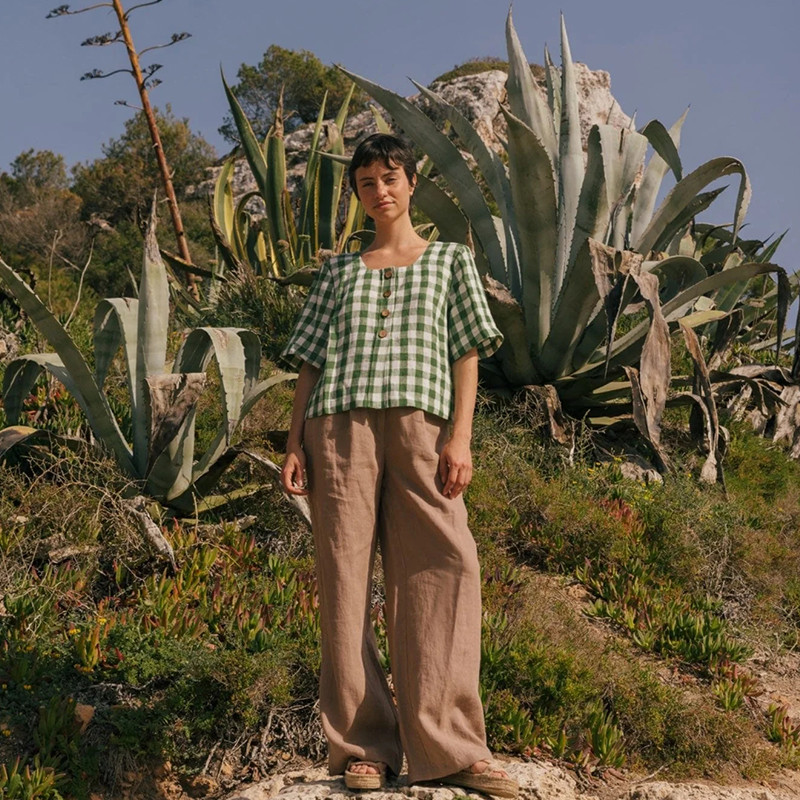
Linenwind Sourcing Our linen begins as fibre flax grown in Europe, principally in France, Belgium and the Netherlands, where the maritime climate and long-established growing tradition produce long, strong bast fibre. That fibre is spun into yarn and woven into cloth either in European mills or, for many programmes, in Chinese mills operating from European yarn. The finished garments are cut, sewn and trimmed at our own factory in Dongguan, China. So the short answer is that the fibre is usually European, the weaving may be European or Chinese, and the garment is always made by us in Dongguan. We hold more than 50 stock fabric specifications across a 100 to 260 GSM range, so a buyer can sample quickly, and we disclose which stage of the chain any linen claim refers to rather than compressing the whole story into one sentence. Buyers usually ask this question to settle three separate things at once, and a useful answer separates them rather than answering only the easiest one. The first is fibre origin: where the flax was grown. The second is mill location: where the yarn was spun and where the cloth was woven. The third is garment origin: where the item was cut and sewn. A single linen shirt can involve three different countries, and each of the three answers can be documented independently. We answer all three because a brand that markets a linen garment needs to know which stage any claim attaches to. Saying "our linen is European" is accurate if the fibre is European, but it becomes misleading if a customer reads it as meaning the garment was made in Europe. The cleanest way to handle the question is to state the fibre origin, the weaving location and the manufacturing location as three facts, then keep a document for each. Our note on what 100 percent European linen means explains how origin claims attach to stages, and it is the framing we use with buyers. Useful habit: write the three origins (fibre, fabric, garment) into your product brief before sampling. It prevents a marketing sentence from drifting away from what the order file actually says. Separating the three origins also makes verification cheaper for the buyer. If the claim you intend to publish is about fibre, you only need to evidence the fibre tier, which is usually a certificate and a yarn specification. If the claim is about manufacturing, you need the factory records instead. Deciding this before sampling means you ask the right supplier for the right document once, rather than discovering at launch that the evidence you need was never collected. It is also the difference between a sourcing answer that survives a retailer questionnaire and one that has to be quietly rewritten. The bulk of the linen we buy is European fibre flax. The main growing belt runs through northern France, Belgium and the Netherlands, where fibre flax has been cultivated for generations, where the crop relies largely on rainfall rather than irrigation, and where retting and fibre extraction are established local industries. Fibre flax is bred for a tall unbranched stem and a high proportion of long bast fibre, which is why it produces the fine, strong yarn that apparel linen depends on. Buyers who want a deeper explanation of why that fibre behaves and prices the way it does can read our guide to European linen quality and features. We also work with certified fibre when a brand needs it, including organic linen programmes and fibre carrying the recognised organic certification chain. Certified organic linen is not simply a marketing variant of standard linen: it changes the documentation that travels with the fibre from farm level onward, and it requires transaction certificates that link quantities between named parties. Where a brand needs that evidence, we build it into the order rather than promising it after the fact, and the process is described in our overview of organic linen and how it is certified. Our fibre answer on whether manufacturers use European flax linen covers the same ground in a shorter form. One qualification is worth stating plainly. We do not claim that every linen we handle is organic or that every fibre batch is European. Some programmes are specified on cost or construction grounds and use non-certified fibre, and some use European yarn woven in Asia. What we do claim is that we will tell you which case applies to your order, and that we will not label a product as certified when it is not. Sourcing decisions are made mill by mill rather than by region, because the same country can contain mills of very different quality. The sequence below is how we assess a mill before it enters a programme, and it is also the sequence a buyer can use to check our own sourcing. The same logic applies when a brand compares sourcing models rather than individual mills. Choosing between a European mill and a Chinese mill woven from European yarn is a trade-off in cost, minimum order quantity at the mill, and access to specific constructions, and our framework for qualifying a linen factory can be applied to the mill tier with a few adjustments. Most first orders are built from our stock fabric programme rather than from a custom weave, because it removes the mill lead time and the mill minimum from the critical path. The table below sets out what that programme contains and how it maps onto a typical order. Figures are our standard working ranges for custom linen programmes and shift with fabric choice, construction complexity, colour count and order size. Stock availability does not mean stock quality is average. The specifications we hold are the ones our customers order repeatedly, chosen for consistent behaviour in cutting, sewing and washing, which is why we can quote them without a sampling delay. If a brand needs a construction we do not hold, we source it from a mill and the timeline lengthens accordingly. We explain the trade-offs in our guide to certified and sustainable linen manufacturing in China. Sourcing is only as good as the paperwork behind it, so we keep the evidence with the commercial record. The checklist below lists what we can provide for a typical order, and it doubles as a request list a buyer can send us before placing bulk. Where a document is issued by a third party, we give you the certificate number so you can check it independently rather than taking our word for it. Our article on linen manufacturer certifications explains what each scheme covers, and the companion answer on how to verify a manufacturer certification walks through the independent check. Buyers who ask about origin are usually also planning a first order, so it helps to put the commercial terms next to the sourcing answer. The grid below summarises the parameters we quote most often. Sample fees run from 40 to 150 US dollars depending on the style and the number of components, and they are refunded against bulk production. Swatches are provided free, which matters when a brand is narrowing a colour or weight decision and does not want to pay for sampling before it has chosen. Quotations are issued within 3 to 7 working days and initial replies within 48 hours, and both timelines are held even when a sourcing question requires us to confirm a mill before we can answer it. Timeline caveat: the ranges above assume stock fabric and an approved counter sample. A custom weave, a certified fibre programme, or a new colour developed from scratch adds mill lead time and, in some cases, a mill minimum order that exceeds our garment MOQ. We will tell you when a request falls into that category rather than quoting our standard schedule. Trustworthy sourcing answers include the limits, so here are ours. We do not publish invented case studies, fabricated statistics, or certification numbers attached to products they do not cover. We do not describe non-certified fibre as organic. We do not claim that a European fibre origin automatically makes a garment European-made, and we do not present a supplier logo as if it were verified proof of anything. Where a claim needs a document, we say so, and where a request is outside what we can evidence, we say that too. Two related points are worth adding for buyers building a defensible position. First, traceability improves with volume: a small first order is normally verified through certificates and lot tracing, while on-site audits of upstream tiers make more sense as volumes grow. Second, our quality system is built to catch problems before shipment rather than to argue about them after. The inspections we run during production are described in our answer on quality inspections during linen clothing production and, in longer form, in our guide to linen supply chain transparency from flax field to finished garment. If you need to confirm fibre origin, mill location or documentation before you commit to a programme, the fastest route is to send us your brief with the three origins you expect and the documents you need to hold. We will confirm what we can evidence for your specific order, propose stock specifications that fit the brief, and quote sampling and bulk at the same time so the commercial picture is complete. Ask us for the fabric specifications, certification documents and quotation behind your next linen order. Sourcing terms, MOQ, sampling and lead-time figures above reflect our standard custom linen programme. Certification claims apply only where the relevant certificate covers the specified material or site. For general buyer questions, see our FAQ section, and for fibre quality context see what makes European linen high quality.Where Does Your Linen Come From?
What the Question "Where Does Your Linen Come From?" Really Asks
Our Fibre Sources: European Flax and Certified Options
How We Choose and Verify a Fabric Mill
Our Stock Fabric Programme in Numbers
Item What we hold or quote Why it matters to a buyer Stock fabric specifications More than 50 specifications Sample without waiting for a custom weave and without a mill minimum Weight range held 100 to 260 GSM Covers light shirting through heavy overshirt and trouser weights Minimum order quantity 60 pieces per style per colour Low enough for a first collection or a test colour Counter sampling 7 to 12 days, working window 7 to 14 days Predictable approval before bulk is committed First-wash shrinkage 3 to 7 percent Buyers can plan sizing and care messaging with a known range Inspection standard AQL 2.5 An agreed sampling plan rather than a verbal assurance What We Can Document for Your Order
Lead Times, MOQ and Sample Terms for Sourced Linen
60 pieces per style per colour
7 to 12 days, window 7 to 14 days
25 to 35 days after approval
35 to 60 days delivered
What We Do Not Claim
Next Steps